Let me say the quiet part out loud: your rankings probably didn’t drop. Your clicks did. And if you’re still walking into client meetings talking about traffic and position tracking without addressing that distinction, you’re already behind.
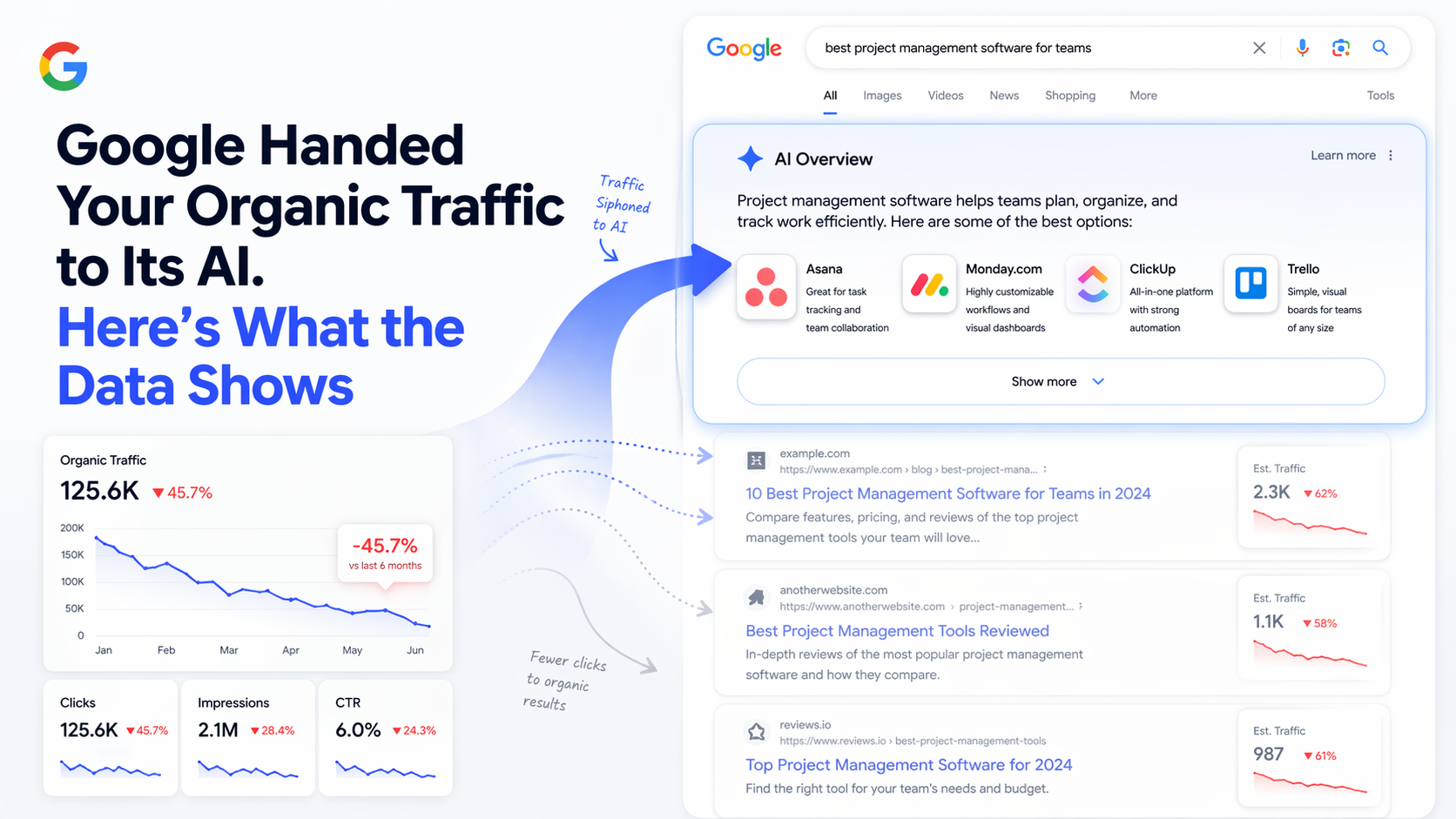
Google didn’t break your SEO. It redirected the traffic to its own AI, kept users on its own page, and handed you impressions as a consolation prize. The data in 2026 makes this impossible to ignore, and yet, a significant portion of this industry is still running the same playbook from 2023.
Here’s what’s actually happening.
What AI Mode and AI Overviews Actually Did
Google’s AI Overviews, the AI-generated answer blocks that appear above organic results, went from a limited experiment to a dominant SERP feature at a pace most agencies weren’t prepared for. As of April 2026, AI Overviews appear on roughly 48% of all Google queries, up from 31% in February 2025. That’s a 58% increase in just over a year.
Then there’s AI Mode, Google’s fully AI-driven search interface, available to all U.S. users since March 2026. When a user activates AI Mode, there are no ten blue links. There’s a conversational AI response, with links buried inside it. The traditional SERP, as most people knew it, is now optional.
This is not a feature rollout. It’s a structural shift in how Google monetizes attention.
The Numbers You Need to See
The data is unambiguous, and most of it came out in the first few months of 2026.
According to Seer Interactive’s research, reported by Search Engine Land in January 2026, organic CTR for informational queries with AI Overviews present dropped 61%, from 1.76% to just 0.61%. Paid CTR on those same queries fell 68%, from 19.7% to 6.34%.
Here’s the part that doesn’t get discussed enough: even queries without AI Overviews saw organic CTR decline by 41%. Users are clicking less everywhere. It’s not just the AI blocks. It’s a behavioral shift that the AI blocks accelerated.
Ahrefs published an analysis of 300,000 keywords in February 2026 showing that even the #1 ranked position loses 34.5% of its CTR when an AI Overview appears on the page. You can rank first and still lose more than a third of your clicks.
On zero-click behavior, the numbers are stark. According to Digital Applied’s comprehensive 2026 analysis, 64.82% of all Google searches now end without a single click to any external site. On mobile, that figure climbs to 77.2%. In AI Mode specifically, it reaches 93%. And Click-Vision’s 2026 report puts the zero-click rate for searches that trigger AI Overviews at 83%.
Read that back: 8 out of 10 users who trigger an AI Overview never visit a website. As of April 2026, AI Overviews now reach an estimated 2 billion users monthly.
Who’s Getting Hit and Who Isn’t
Not every industry is absorbing this equally, and that matters a lot if you’re managing search for clients across different verticals.
BrightEdge tracked AI Overview prevalence across nine industries from February 2025 through February 2026. The results are significant: Healthcare is at 88% AI Overview presence, Education at 83%, and B2B Technology at 82%, up from 36% just one year ago. If you produce informational content in any of those categories, the AI is answering your users’ questions before they ever see your page.
E-commerce is in a different position. As of early 2026, AI Overviews appear on approximately 14% of shopping queries, according to Visibility Labs’ analysis of over 20.9 million shopping keywords. That’s still a 5.6x increase from late 2024, but compared to B2B tech or healthcare, product-focused content has meaningful breathing room. For now.
The clearest pattern: content that can be fully summarized by an AI gets summarized. Guides, tutorials, FAQs, definitions, how-to posts, this is exactly what AI Overviews are built to absorb. If your content strategy is built on high-volume informational posts, you are the primary target. If you’re producing transactional, service-specific, or deeply proprietary content, you have more protection.
What This Means If You’re Running Search for Clients
Here’s the honest conversation most agencies are avoiding.
If a client’s impressions are holding steady or growing while clicks and CTR are falling on informational queries, AI Overviews are most likely the cause. That’s not a recovery problem, it’s a measurement problem. And if you’re still presenting organic traffic as the headline KPI without context, you’re telling a story that obscures what’s actually happening to their visibility.
There’s also a ranking correlation issue that surfaced early in 2026 that deserves attention. In mid-2025, roughly 75% of URLs cited in AI Overviews also ranked in the top 10 organic results. By February 2026, that overlap had collapsed to between 17% and 38%, according to BrightEdge data cited by Mersel AI. Meanwhile, BrightEdge also reported a 400% increase in AI citations pulled from positions 21 through 30, with 89% of all AI citations now coming from beyond the top 100 organic listings.
That’s not a minor shift. High organic rankings no longer guarantee AI visibility. These are now two separate competitions, and most reporting frameworks aren’t built to reflect that.
What’s Actually Working Right Now
There is a clear upside in the data that shouldn’t be buried. Brands cited inside AI Overviews earn 35% more organic clicks and 91% more paid clicks than brands that aren’t cited, per Seer Interactive’s research. And according to Mersel AI’s March 2026 analysis, AI-referred traffic converts at 4.4x the rate of standard organic traffic, because those visitors arrive already informed and further along in their decision-making.
The goal has shifted. You’re no longer just trying to rank. You’re trying to get cited. And the strategies that earn citations are different from the ones that earn rankings.
Based on current data, here’s what’s working:
Lead with direct answers. AI models pull from the beginning of content. Forty-four percent of AI citations come from the first 30% of text. Stop burying your point. Answer the query in the first paragraph, then build context around it.
Use structured data. According to BrightEdge’s 2026 data, sites with author schema markup are 3x more likely to appear in AI-generated answers. FAQPage schema shows a 67% citation rate for relevant queries. If you haven’t implemented structured data, that’s a gap that’s actively costing you.
Publish original data. Marketers publishing proprietary research report 61% stronger organic performance and 64% higher conversion rates. AI engines cite sources that have something no one else has. Generic summaries of existing information don’t get cited, they get replaced.
Keep content fresh. Pages updated within the last 60 days are 1.9x more likely to appear in AI search results. Pages going more than three months without an update are 3x more likely to lose AI visibility entirely.
Diversify what you measure. Clicks and sessions are no longer sufficient as headline KPIs for informational content. Share of voice, citation frequency, branded search volume, and AI visibility need to be in the reporting conversation.
The Bottom Line
This isn’t an SEO obituary. Search is still generating traffic. It’s just distributing it differently. Gartner projects a 50% decline in organic traffic to websites by 2028 as generative AI search continues to scale. That’s not a ceiling, it’s a trajectory.
The agencies and in-house teams that will be fine are the ones having honest conversations with clients right now: about what the data actually shows, about what the real KPIs should be, and about what it takes to earn visibility in a search environment where ranking and being cited are no longer the same thing.
The ones still running 2023 playbooks and calling it strategy won’t have a great 2026.
Sources: Search Engine Land (January 2026), Seer Interactive, Ahrefs (February 2026), BrightEdge / ALM Corp (March 2026), Mersel AI (March 2026), Digital Applied (April 2026), Click-Vision (2026), Averi.ai State of AI in Marketing (March 2026), Visibility Labs / ALM Corp (March 2026)